


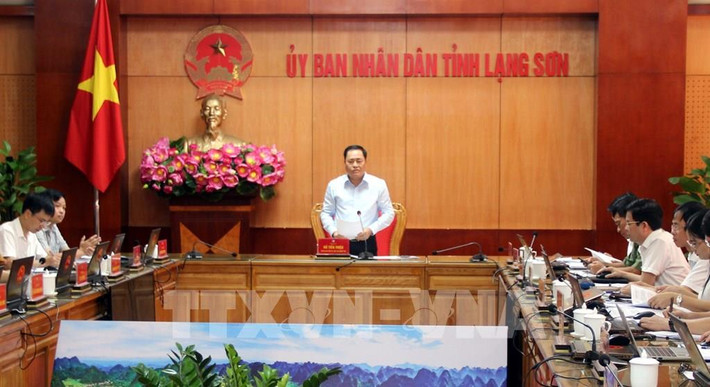
(People’s Representative) – Departments, branches, and localities across Lang Son Province are working together to support investors, address challenges, expedite construction progress, and complete infrastructure in industrial parks and clusters. This initiative aims to attract secondary investors to set up facilities in the area. This directive was issued by Chairman of Lang Son Provincial People’s Committee Ho Tien Thieu during a meeting on August 6 with leaders of relevant units, localities, and enterprises to discuss investment and infrastructure construction for industrial parks and clusters.
Deputy Director of the Department of Planning and Investment of Lang Son province, Ha Manh Cuong, provided a progress report on the VSIP Lang Son Industrial Park (located in Huu Lung district). The park, which began infrastructure construction in June 2024 and encompasses nearly 600 hectares of land, is currently developing its first phase on a 200-hectare area. The Huu Lung district People’s Committee has completed a census of over 490 cases impacted by the project and cleared more than 57 hectares of land.
However, the project has encountered hurdles in site clearance. The current cleared area handed over to the investor is not sufficient to begin infrastructure construction. Local authorities and the project investor explained that the large scale of the project necessitates careful verification of ownership, land asset inventory data, and land plot boundaries to ensure accurate identification of compensation, support, and resettlement subjects according to regulations. This process takes time to complete.
The provincial Department of Industry and Trade has identified nine industrial clusters across the province, encompassing a total area of approximately 372 hectares. These clusters include Hop Thanh 1, 2 (Cao Loc district), Bac Son 2 (Bac Son district), Dinh Lap (Dinh Lap district), Ho Son 1, Hoa Son 1 (Huu Lung district), and Na Duong 1 and 3 (Loc Binh district). Currently, only Local Industrial Cluster No. 2 (Cao Loc district), with an area of 8.5 hectares, is operational and fully occupied. The remaining eight industrial clusters are undergoing legal procedures to establish technical infrastructure and are facing challenges in land procedures, site clearance, and resettlement arrangements.
At the meeting, Chairman Ho Tien Thieu reaffirmed Lang Son Province’s unwavering commitment to developing its industrial sector. This development is a key driver of economic and social progress, job creation, and the realization of the province’s full potential for economic and industrial growth. The province has designated industrial parks and clusters as one of the four pillars of its socio-economic development strategy by 2030. It further aims to develop its industry towards improved quality, increased value, and competitiveness by 2050, with a focus on green industries that will propel the province’s economic growth and development.
Chairman Thieu emphasized that achieving these goals requires a collaborative effort from districts, cities, departments, branches, units, and infrastructure investors to overcome the challenges and obstacles encountered in the process of building and developing industrial parks and clusters. Particular focus should be placed on accelerating the progress of large-scale industrial parks and clusters that significantly impact people’s lives and the provincial economy, such as the VSIP Lang Son Industrial Park.
Districts and cities are urged to heighten their sense of responsibility and mobilize the participation of the entire political system, including relevant agencies and entities involved in industrial zone and cluster projects. They must work swiftly to eliminate bottlenecks in investment, land allocation, site clearance compensation, and resettlement. Each agency, locality, and unit, within their designated capacities, should prioritize resolving emerging issues to prevent delays and negative consequences that could hinder project progress.
Local governments are called upon to proactively establish and incorporate industrial development and resettlement areas into their planning strategies. Once a decision is made to develop industrial zones and clusters in an area, project implementation must commence immediately to ensure progress and quality. Leaders will be held accountable for the successful completion of these tasks.
Functional agencies and units are tasked with meticulously appraising and evaluating the financial capacity and project implementation capabilities of contractors. This is crucial to avoid situations where project investors change due to insufficient capacity.
Investors involved in projects to build infrastructure for industrial zones and clusters are encouraged to maintain close collaboration with relevant functional agencies to promptly address any obstacles that may arise. They are also expected to submit recommendations to the Provincial People’s Committee on issues within its purview. Notably, investors are responsible for allocating funds to cover site clearance costs for households according to the approved plan. Additionally, they must prepare all necessary conditions and resources to commence construction of technical infrastructure on the cleared and handed-over area.
Vu Van Dat
(According to daibieunhandan.vn)